

T: +86-15888736999
No.67, Wutong Rd, Three-Two Rd Binhai Industrial Park, Economic & Technoloical Development Zone, Wenzhou, Zhejiang, China

Views: 0 Author: Site Editor Publish Time: 2026-10-30 Origin: Site


Mixing differing sanitary standards across processing lines creates a dangerous operational reality. Facility operators often discover mismatched components too late. This oversight remains a leading cause of system leaks, failed CIP/SIP validations, and bacterial entrapment. You need a reliable method to align every component properly before fluids enter the system.
This guide evaluates the dimensional tolerances, sealing geometries, and regional compliances of major standards. We help you ensure safe, scalable, and audit-ready piping integrations across your entire plant. You will gain a clear framework for evaluating and matching hygienic unions. We empower process engineers and procurement teams to connect sanitary lines without risking process integrity.
You will learn how to identify subtle differences in global measurements. You will also understand the exact mechanical behaviors of different threading and clamping designs. Finally, we provide actionable steps to safeguard your hygienic fluid paths from avoidable contamination.
ASME BPE strictly governs high-purity biopharma applications using imperial Tube OD measurements, demanding rigorous surface finish (Ra) documentation.
The primary operational difference in DIN vs SMS sanitary fittings lies in thread design and seal geometry; they are rarely interchangeable without custom adapters.
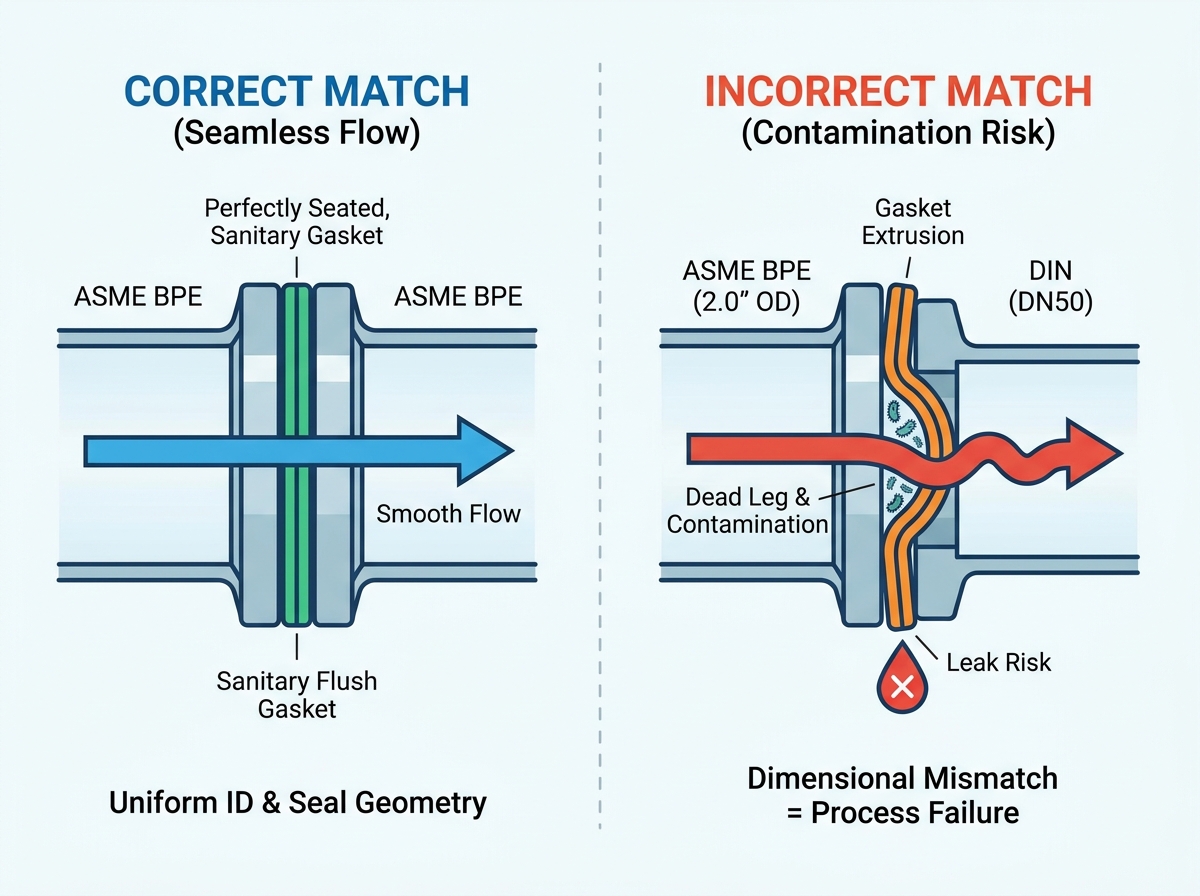
Dimensional mismatch (e.g., pairing a DN50 metric ferrule with a 2-inch imperial gasket) inevitably creates dead legs, even if the outer clamp physically closes.
Selecting the right sanitary valve connection standards depends on regional facility footprint, CIP/SIP rigor, and specific industry compliance (EHEDG, 3-A, or FDA).
Facility managers often underestimate the impact of subtle dimensional discrepancies. A mismatched joint might appear sealed from the outside. Inside the pipe, it tells a completely different story. Minor deviations compromise fluid dynamics and threaten overall product safety.
Microscopic mismatches in internal diameters create dangerous crevices. Product pools in these hidden gaps during normal operation. Clean-in-place (CIP) chemicals cannot reach these shadowed areas effectively. Bacteria then multiply rapidly in the stagnant fluid. This cascading failure ultimately causes total batch loss. We call these stagnant zones dead legs, and they are the enemy of aseptic processing.
Incompatible ferrule faces compress elastomers unevenly. When you tighten a clamp over mismatched flanges, the gasket pinches. The elastomer then extrudes directly into the product stream. Thermal cycling worsens this effect significantly. Hot steam during sterilization expands the metal and the seal. As it cools, the over-stressed elastomer tears. These fragments contaminate the product, and you lose the hygienic seal simultaneously.
Incorporating mismatched sanitary pipe fitting connections triggers immediate red flags during regulatory audits. EHEDG and FDA inspectors examine fluid paths rigorously. They demand full material traceability for every joint. Non-standard adapters usually lack proper documentation or heat numbers. You risk failing critical inspections when you cannot prove the physical compatibility of your piping infrastructure.
Different global regions developed unique sanitary valve connection standards based on local manufacturing habits. You must understand their specific criteria to avoid integration disasters. Each framework dictates specific metallurgical properties and physical dimensions.
This standard dominates the North American biopharma and semiconductor sectors. It leaves no room for interpretation. Engineers built ASME BPE strictly for high-purity applications. It relies on precise imperial measurements based on Tube Outside Diameter (OD). The standard dictates exact sulfur content in 316L stainless steel to ensure perfect automatic orbital welding. It also mandates rigorous surface roughness levels, cataloged as SF1 through SF4. You must provide extensive documentation for every ASME BPE component.
European food, beverage, and chemical processing plants rely heavily on DIN standards. They utilize metric nominal sizing, known as DN. DIN 11851 features robust round threads designed for heavy industrial use. However, high-purity applications often require DIN 11864. This upgraded standard provides aseptic flanged or O-ring designs. DIN 11864 meets much higher hygiene demands by eliminating the microscopic crevices found in older thread profiles.
The global dairy and beverage industries adopted SMS widely. It originated in Sweden but now serves facilities worldwide. SMS components feature distinctive round slotted nuts. They use flat square seals rather than O-rings. Operators favor SMS because it allows extremely quick assembly and disassembly. You will find it frequently in high-volume hygienic lines where manual cleaning happens regularly.
ISO provides broad international standardization. ISO 1127 and ISO 2037 combine metric outside diameters with varied wall thicknesses. You see them often in general hygienic installations. They offer a versatile middle ground for global projects. However, the varying wall thicknesses mean you must calculate internal diameters carefully before mating them to other systems.
Comparing DIN vs SMS sanitary fittings reveals stark mechanical differences. Many plant managers assume European standards interchange easily. This assumption causes immediate line failures.
DIN 11851 uses a very pronounced, robust round thread. It requires a specific D-shaped seal to close the fluid path. The male and female parts interlock deeply. SMS uses a much coarser, round-slotted nut design. It relies on a flat lip seal to prevent leaks. They function entirely differently under compression. The threads do not align, and the elastomer profiles serve different compression physics.
You must evaluate typical pressure tolerances before selection. DIN generally supports higher pressure thresholds. This advantage becomes obvious in larger pipe diameters. The deep round threads distribute stress evenly. Standard SMS unions handle normal dairy processing pressures perfectly. However, they may distort or leak under extreme hydraulic shock or heavy steam pressure.
Assess the ease of manual teardown versus in-line cleanability. SMS allows rapid manual uncoupling. Workers can easily open the slotted nuts using simple spanners. DIN requires slightly more effort to disassemble. Furthermore, traditional DIN 11851 often requires upgraded seals to meet modern aseptic standards. You must specify SIP-capable (Sterilization-in-Place) gaskets for DIN unions to survive intense thermal cycles.
We must state a critical warning clearly. Despite similar visual profiles, DIN and SMS components are completely incompatible. You cannot cross-thread them. You cannot force an SMS nut onto a DIN male part. Mating them causes severe localized leaks. The metal will gall, the threads will strip, and the seal will fail instantly.
Operational safety relies heavily on mathematical exactness. You cannot trust visual similarities when joining process pipes.
A core mathematical discrepancy exists between global measurement systems. ASME and 3-A use imperial outer diameter (OD) measurements. A 2-inch pipe measures exactly 2 inches on the outside. DIN and ISO use metric nominal volume measurements (DN). A DN50 pipe focuses on the internal bore capacity, not a strict outer dimension. They do not align cleanly. You always face a fractional millimeter difference.
Operators sometimes try to force mismatched components together. Consider a 2.0-inch ASME BPE ferrule. It has an OD of 50.8mm. A DN50 DIN ferrule has an OD of 53.0mm. They seem incredibly close to the naked eye. You might even manage to close a hinged outer clamp over them. However, they cannot safely share the same hygienic gasket. The internal mismatch creates an immediate dead leg. The outer clamp provides a false sense of security.
Process engineers sometimes use adapters to bridge these standard gaps. They weld concentric or eccentric reducers between the mismatched lines. This introduces sudden pressure drops. Turbulence increases significantly inside the line. Shear forces can damage delicate biological products. You complicate your fluid dynamics unnecessarily when you rely on constant adaptation.
Nominal Size | ASME BPE OD (mm) | DIN 11850 OD (mm) | ISO 2037 OD (mm) |
|---|---|---|---|
1.0" / DN25 | 25.40 | 29.00 | 25.00 |
1.5" / DN40 | 38.10 | 41.00 | 38.00 |
2.0" / DN50 | 50.80 | 53.00 | 51.00 |
2.5" / DN65 | 63.50 | 70.00 | 63.50 |
You must make strategic engineering choices for your plant architecture. Standardizing early prevents endless maintenance headaches later.
Establish strict rules for matching legacy infrastructure. Brownfield expansions demand respect for existing pipework. Do not introduce ASME BPE into a fully DIN-standardized European dairy plant. This mixture creates confusion for maintenance crews. Only break this rule if you are establishing a completely isolated, independent high-purity loop.
Map your connection standards directly to your governing bodies. FDA-regulated injectable pharmaceuticals require ASME BPE. The documentation and surface finish requirements are non-negotiable. EHEDG-compliant food processing thrives on DIN or SMS. Understand what your local inspector expects before you order components.
Evaluate the local availability of replacement parts. A highly specialized standard does you no good if you cannot buy spare gaskets locally. Ensure the chosen standard requires Heat Numbers etched directly into the metal. Mandate Material Test Reports (MTRs) for every delivery. EN 10204 3.1 compliance is mandatory for true traceability.
We recommend standardizing your facility using a systemic approach. Follow these specific rules:
Define the primary regulatory requirement for your main product line.
Audit your existing Piping and Instrumentation Diagrams (P&IDs) to identify legacy standards.
Standardize connections at the skid level. Do not mix standards within a single equipment frame.
Mandate that OEMs deliver modular skids with battery-limit connections matching your master facility standard.
Operational safety relies entirely on mathematical exactness, not visual similarity. Mismatched internal diameters create contamination traps that chemicals cannot reach. Standardizing your facility's connection types fundamentally lowers procurement complexity. It minimizes critical maintenance errors during reassembly. Furthermore, it ensures seamless sanitary compliance during regulatory audits. We strongly advise you to audit your current P&IDs and piping specifications immediately. Complete this verification before procuring replacement valves or expansion skids to protect your processing environment.
A: No. The thread pitches and sealing faces are fundamentally different. Attempting to force them will damage the threads and compromise the hygienic seal. The components will gall, leading to permanent structural damage and guaranteed leaks.
A: No. While the clamp mechanism itself may fit over the external flanges, the internal bore sizes (ID) vary wildly between ASME BPE, ISO, and DIN. Mismatching these components leads to immediate dead legs and contamination risks.
A: ASME BPE is the global benchmark for biopharma. It features rigorous specifications regarding surface finish, strict material composition limits, and flawless aseptic weldability. Inspectors globally recognize it as the highest purity standard.
A: Measure the outside diameter (OD) of the tubing and the flange diameter precisely. Check for standard stamps like 3-A or ASME. Look for material heat numbers etched into the valve body. Cross-reference these specific dimensions with engineering standard tables.