

T: +86-15888736999
No.67, Wutong Rd, Three-Two Rd Binhai Industrial Park, Economic & Technoloical Development Zone, Wenzhou, Zhejiang, China

Views: 0 Author: Site Editor Publish Time: 2026-10-08 Origin: Site


In high-purity processing, the hidden dead space inside a standard valve serves as a primary vector for batch contamination and extended downtime. Process engineers and facility managers routinely face a difficult choice between standard industrial sanitary valves and fully encapsulated non-retention designs. Making the wrong selection inevitably leads to failed audits, severely compromised product integrity, and soaring labor costs associated with manual teardowns.
This guide provides an evidence-based comparison of cavity designs across various processing environments. We closely evaluate how a properly specified cavity-filled option impacts CIP/SIP efficiency, regulatory compliance, and overall hygienic performance compared to standard alternatives. By understanding these exact mechanical differences, you can protect your production lines from hidden microbial risks. You will learn the anatomical distinctions between seat designs, discover how they dictate your daily maintenance routines, and gain an actionable framework for making the right engineering choice.
Engineers must thoroughly understand the anatomical divide between standard and encapsulated valve bodies. Operators often struggle when they ignore the complex fluid dynamics occurring within standard housings. A conventional floating ball valve relies on two separate internal seats. These seats suspend the metal sphere inside a much larger stainless steel housing. This mechanical gap creates a distinct dead zone around the sphere exterior.
When you actuate a standard valve, media inevitably bypasses the primary seals. It rapidly floods the internal void. Trapped fluid loses velocity immediately. Stagnation occurs within minutes. Bacteria multiply aggressively in these undisturbed pockets. Media crystallization poses another serious threat to your system. Sugars, salts, and thick syrups harden inside the housing overnight. This abrasive buildup eventually scores the metal and destroys your elastomeric seals during subsequent actuations.
Conversely, engineers designed the non-retention sanitary ball valve specifically to eliminate these hidden voids entirely. Manufacturers utilize advanced cavity-filled seating technology. They machine virgin PTFE or modified TFM inserts to exacting tolerances. These precision components completely surround the rotating sphere. The filler material occupies every available micrometer of empty space within the housing.
This specific design creates a perfectly flush internal profile. Fluid remains strictly confined to the designated central flow path. Media simply cannot penetrate the surrounding valve body. You effectively neutralize the risk of fluid stagnation. The encapsulated seat prevents cross-contamination between sequential product batches.
Table 1: Cavity Design Comparison
| Feature | Standard Ball Valve | Non-Retention Ball Valve |
|---|---|---|
| Internal Cavity | Exposed void around the sphere | Fully encapsulated by PTFE/TFM filler |
| Fluid Dynamics | Media bypasses seats and stagnates | Media flows cleanly through central bore |
| Microbial Risk Level | High (Requires manual teardowns) | Extremely Low (Supports automated cleaning) |
| Ideal Application | Utility lines, clean steam, air | Direct food, dairy, biotech product contact |
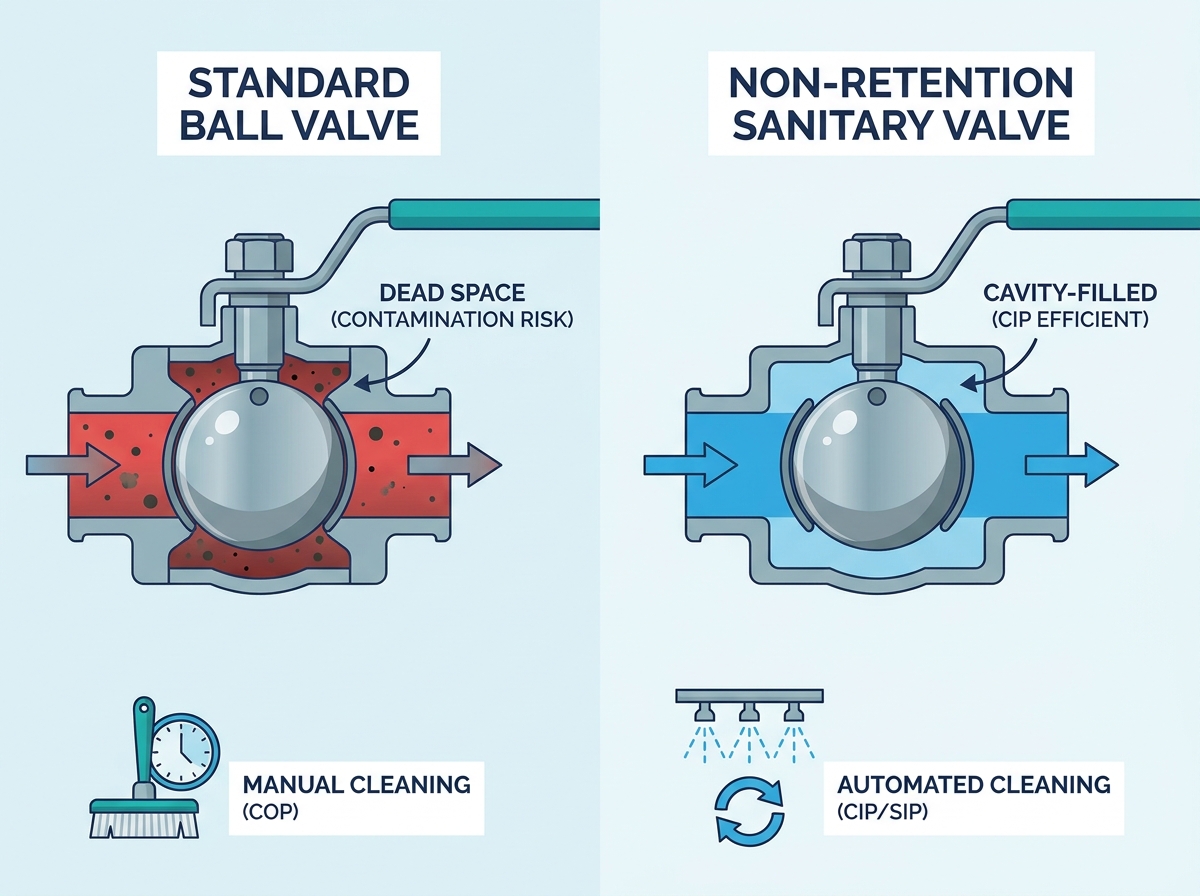
Standard valves consistently fail basic washdown scenarios in high-purity environments. Traditional cleaning fluids cannot effectively penetrate deep internal voids. Automated CIP flow lacks sufficient velocity to flush trapped particulates from narrow mechanical gaps. We see standard components repeatedly fail routine riboflavin validation tests.
Because automated cleaning fails, operators must rely heavily on Clean-Out-of-Place (COP) protocols. COP requires complete line shutdowns. Technicians must physically remove the unit from the piping system. They disassemble the components manually on a workbench. They scrub the seats, replace worn O-rings, and reassemble the hardware. This intensive process consumes expensive dedicated labor. You lose valuable production hours daily. Furthermore, frequent manual teardowns degrade elastomeric seals rapidly, leading to unexpected leaks.
Upgrading your infrastructure optimizes sanitary ball valve cleaning significantly. Fully encapsulated seats facilitate uninterrupted Clean-In-Place (CIP) operations. They also support highly reliable Sterilize-In-Place (SIP) routines. The flush internal profile allows chemical cleaning agents to sweep the bore completely. You achieve the required fluid shear forces easily. Facilities report drastic reductions in overall cleaning cycle times. Chemical consumption drops significantly. Wastewater generation decreases measurably.
However, you must actively manage specific implementation risks. Temperature limitations require careful engineering oversight. Facility managers must verify their SIP steam temperatures before installation. High-temperature steam can exceed the thermal tolerance of standard PTFE fillers. If you push your system beyond 150°C (302°F) frequently, unmodified PTFE may deform or experience cold flow. We recommend specifying modified TFM seats for aggressive thermal cycling. Always audit your peak SIP temperatures to ensure material compatibility.
Regulatory bodies scrutinize direct product-contact lines aggressively. Industry auditors search specifically for dead legs during routine inspections. Standard designs rarely survive strict hygienic evaluations because they inherently violate core sanitary principles.
Non-retention structures align perfectly with these stringent frameworks. Encapsulated seats provide the exact smooth, crevice-free topography auditors demand. You gain immediate compliance confidence.
Material buildup creates severe cross-contamination risks for processors. Food manufacturers battle trapped allergens constantly. A standard valve might easily harbor peanut protein from a morning batch. If your CIP system fails to flush the cavity, trace allergens will inevitably contaminate the afternoon run. Biopharmaceutical facilities face identical dangers. Active pharmaceutical ingredients (APIs) mixing between batches causes catastrophic regulatory failures and product recalls.
Traceability guarantees material safety across your plant. You must demand verifiable material test reports (MTRs) from your valve supplier. FDA-compliant elastomers are absolutely non-negotiable. Look specifically for USP Class VI certification. This rigorous rating confirms your seats will not leach toxins into high-purity media under extreme temperatures. Verifiable certification protects your brand reputation and ensures consumer safety.
Engineers need a highly structured approach for hygienic ball valve selection. Not every pipeline requires a premium encapsulated design. You must apply application-specific shortlisting logic to optimize your procurement strategy. Standard units serve basic utility applications perfectly well. We frequently specify them for clean steam delivery lines. They handle non-product-contact cooling water safely and effectively. Standard configurations also work excellently for plant compressed air distribution.
Conversely, non-retention bodies are strictly mandatory for direct-contact hygienic media. Process lines carrying viscous fluids like syrups, lotions, or purees demand cavity-filled seats. High-sugar contents crystalize rapidly in dead zones, destroying internal mechanics. Active biologics require absolute sterility throughout the flow path. Dairy applications simply cannot tolerate any microbial harborage.
Apply these core criteria during your detailed selection process:
Standard ball valves maintain a highly valid place in utility applications. However, encapsulated models remain a non-negotiable requirement for zero-contamination processing. Direct-contact hygienic lines demand absolute sterility and predictable cleaning cycles. Cavity-filled seats deliver this crucial protection while eliminating manual labor.
Take immediate action to secure your hygienic facility:
A: The filler material exists entirely outside the central bore. Full-port non-retention valves maintain a completely unrestricted flow path. Your media passes through the sphere smoothly without turbulence. The flow coefficient (Cv) remains virtually identical to standard full-port designs. You gain enhanced hygienic performance without sacrificing system pressure or volumetric throughput.
A: Automated CIP eliminates the severe mechanical wear caused by constant manual teardowns. This operational shift often extends seat lifespan significantly. Standard seats degrade quickly during physical removal and reassembly. However, you must still schedule preventative maintenance. Abrasive media or frequent thermal cycling will eventually necessitate seat replacement to maintain compliance.
A: Manufacturers machine valve bodies to highly specific, tight tolerances. A standard housing cannot reliably secure an aftermarket encapsulated seat. While some modular brands advertise interchangeable seat swaps, we strongly advise against it. Attempting retrofits compromises the internal seal integrity. You must specify a factory-built non-retention valve to ensure complete sanitary compliance.