

T: +86-15888736999
No.67, Wutong Rd, Three-Two Rd Binhai Industrial Park, Economic & Technoloical Development Zone, Wenzhou, Zhejiang, China

Views: 0 Author: Site Editor Publish Time: 2026-10-15 Origin: Site


Selecting the right fluid control equipment is never just a mechanical necessity. It acts as your critical line of defense against product contamination, unplanned downtime, and regulatory failure. Dairy processing introduces uniquely harsh conditions to fluid networks. You must manage challenges ranging from abrasive lactose crystallization and high-fat content to aggressive thermal cycling during routine Clean-in-Place (CIP) and Sterilize-in-Place (SIP) operations. Failing to match internal geometries to these conditions creates immediate vulnerabilities.
This guide provides process engineers and plant managers a pragmatic, evidence-based framework for evaluating fluid routing options. We aim to help you confidently shortlist the best fluid control mechanisms based on fluid dynamics, material science, and operational longevity. You will learn how to match specific geometries to dairy product characteristics while ensuring absolute compliance. Properly specifying these components prevents premature failures and guarantees continuous, safe processing.
Micro-crevices and dead legs in poorly specified fluid routing systems act as breeding grounds for pathogens. Stagnant zones harbor dangerous bacteria, including Bacillus and Listeria. Once these microbes establish biofilms, standard CIP protocols often fail to dislodge them. This persistent contamination leads directly to batch spoilage. Severe cases result in catastrophic product recalls. Recalls destroy brand reputation and invite intense regulatory scrutiny.
Improper sizing or actuation failures disrupt continuous processing lines. When a component fails to open or close fully, fluid pressures fluctuate. These fluctuations cause production bottlenecks. Process engineers must carefully calculate flow coefficients (Cv) to maintain steady yield rates. Actuators lacking adequate torque will stall halfway through a cycle. This stalling triggers system alarms and halts production entirely.
You must also understand the strict threshold between hygienic and aseptic environments. Pasteurized milk requires stringent hygienic standards. Equipment must drain completely and resist bacterial buildup. However, UHT (Ultra-High Temperature) milk processing demands specialized aseptic equipment. Aseptic designs utilize steam barriers and PTFE bellows to prevent any external microbes from entering the product stream. These advanced barriers guarantee extended shelf life (ESL) for sensitive dairy liquids.
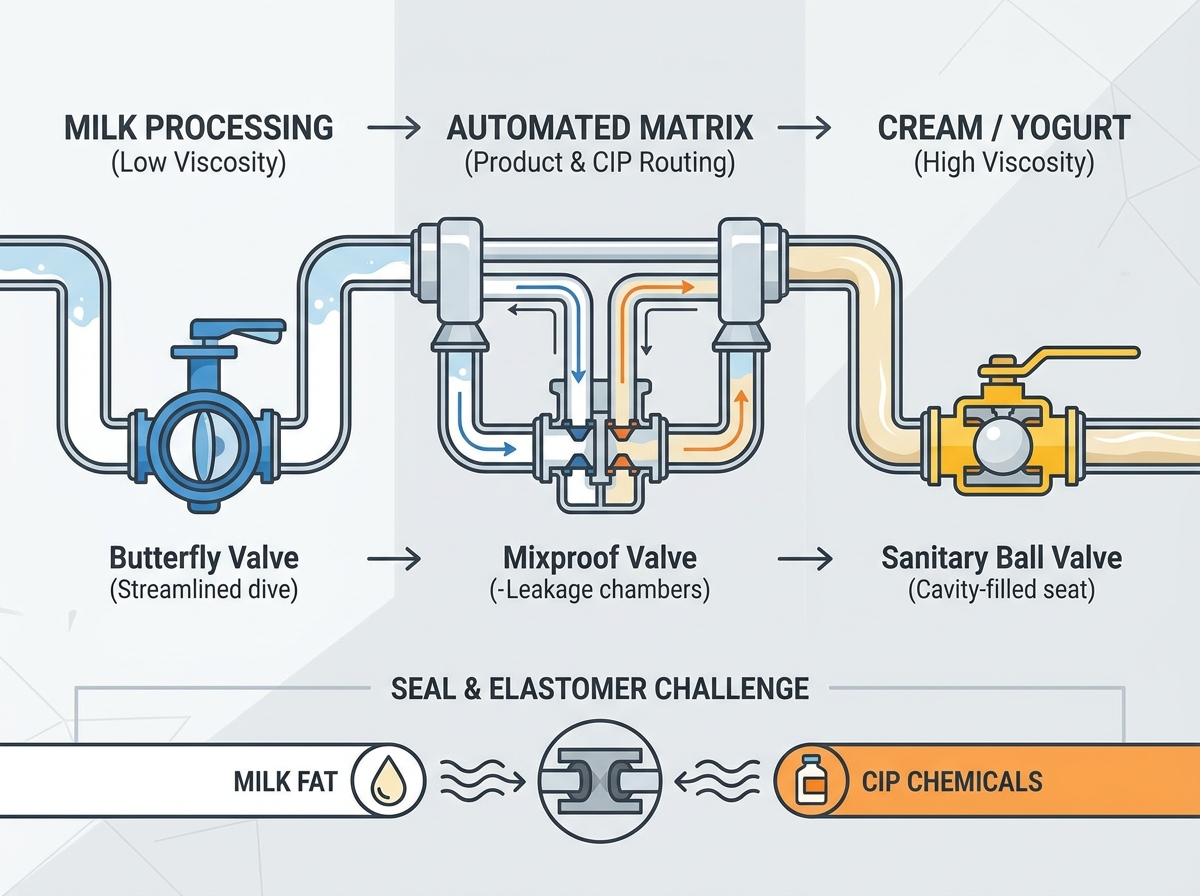
Butterfly designs offer reliable performance for standard, low-viscosity whey routing. We strongly recommend specifying hygienic valves for milk processing when dealing primarily with raw or pasteurized liquid milk. These units operate using a central disc turning parallel to the flow stream.
When evaluating these models, look closely at the disc profile. Streamlined discs minimize flow resistance and reduce sheer stress on sensitive dairy liquids. Assess the reliability of the internal seat ring under constant pressure. The seat must compress uniformly around the entire disc edge. However, you should acknowledge their limitations. Butterfly architectures perform poorly in high-pressure environments. Highly viscous products also tend to stick behind the central disc spindle.
Viscous liquids demand entirely different fluid dynamics. Cream, yogurt, butter, and cultured products require unobstructed, full-port flow. Any restriction in the pipeline causes pressure spikes and degrades product texture.
You must evaluate internal cavity structures carefully. Standard industrial models allow fluid to pool around the central sphere. These pools quickly become dangerous bacterial breeding grounds. To prevent this, sanitary ball valves for dairy processing must feature cavity-filled or fully encapsulated seats. Encapsulation fills all internal voids. It guarantees zero pooling and ensures aggressive CIP fluids can wash all product residues away effectively.
Modern automated dairy plants frequently route product and CIP chemicals simultaneously. Mixproof designs excel here. They permit concurrent product routing and cleaning operations through the same manifold. Two independent seats prevent cross-contamination.
Process engineers must demand evidence of fail-safe leak detection. Mixproof units feature dedicated leakage chambers between the upper and lower seats. If a seal fails, fluid exits through this chamber rather than mixing into the opposite line. You should evaluate maintenance complexity closely. These units contain higher part counts and require specialized tools during routine teardowns.
Valve Architecture Overview Chart
| Valve Architecture | Optimal Dairy Applications | Primary Limitation |
|---|---|---|
| Butterfly | Liquid milk, whey, low-viscosity fluids | Struggles under high pressure and high viscosity |
| Encapsulated Ball | Heavy cream, yogurt, butter, cheese curd | Requires strict cavity-filler verification |
| Mixproof (Double Seat) | Automated manifolds, simultaneous CIP | High mechanical complexity and maintenance time |
Seals face a relentless dual threat inside dairy pipelines. They must resist swelling caused by milk lipids. Simultaneously, they must endure highly alkaline detergents, acidic neutralizing agents, and high-temperature steam during SIP cycles. Finding the perfect elastomer requires balancing chemical resistance against mechanical elasticity.
EPDM (Ethylene Propylene Diene Monomer) serves as the industry standard for general dairy processing. It demonstrates excellent resilience against steam and standard CIP chemicals. However, EPDM has a notable weakness. It remains highly susceptible to degradation when exposed to very high-fat concentrations over extended periods. High milk fats cause EPDM to swell, soften, and eventually tear.
For high-fat lines moving heavy cream or butter, we position FKM (Viton) or PTFE (Teflon) as superior alternatives. FKM resists lipid absorption much better than EPDM. PTFE offers near-universal chemical resistance. Yet, PTFE lacks the natural memory and elasticity of rubber. Using PTFE requires specific internal spring-loading mechanisms to maintain a constantly tight seal against moving metal parts.
Maintenance realities dictate how long these materials survive. We advise establishing a predictive maintenance schedule based on CIP cycles rather than chronological time. Every thermal shock degrades elastomer integrity slightly. Tracking exact CIP cycles prevents unexpected seal fatigue and subsequent pipeline leaks.
Elastomer Compatibility Table
| Elastomer Material | Steam (SIP) Resistance | Milk Fat Resistance | Best Applied In |
|---|---|---|---|
| EPDM | Excellent | Fair to Poor | Standard milk routing, whey lines, CIP circuits |
| FKM (Viton) | Good | Excellent | High-fat cream, butter, cultured dairy |
| PTFE (Teflon) | Outstanding | Outstanding | Aseptic barriers, extreme chemical environments |
Achieving true sanitary design requires strict adherence to surface finish requirements. Precise mechanical polishing prevents biofilm adherence. Inside dairy pipelines, internal surfaces typically require an Ra (Roughness Average) value below 0.8 µm (32 µ-inch). Some critical applications demand electropolishing to smooth microscopic peaks and valleys further. Smooth metal prevents lactose and proteins from baking onto the sidewalls during thermal processing.
You must differentiate between self-claimed "food grade" labels and third-party verified standards. True sanitary valves for dairy applications carry rigorous documentation. Demand proof of 3-A Sanitary Standards certification. This confirms the geometry meets strict North American hygienic rules. Ensure all elastomers hold FDA CFR Title 21 compliance. For European markets or advanced aseptic lines, look for EHEDG (European Hygienic Engineering & Design Group) certification.
Drainability determines whether a system is genuinely cleanable. Process engineers apply the "L/D ratio" rule to eliminate dead legs. A dead leg is a branch in the pipeline where fluid stagnates. The length (L) of any branch divided by its diameter (D) should ideally not exceed 2:1. Furthermore, equipment must be self-draining. Installers must orient the components at specific angles. This orientation guarantees zero pockets remain where flushing fluids could stagnate and foster microbial growth.
Evaluating vendor proposals requires looking deeply at operational realities. Initial procurement represents merely one phase of the lifecycle. Equipment requiring frequent manual breakdowns for cleaning consumes massive amounts of maintenance labor. Extended downtime severely impacts your overall production efficiency. Focus on architectures designed for true CIP compatibility to keep manual teardowns to an absolute minimum.
Standardization of spare parts greatly improves operational efficiency. We recommend shortlisting vendors utilizing universal seal kits across multiple pipe sizes. When actuators and seal kits match across various models, you significantly reduce your MRO (Maintenance, Repair, and Operations) inventory footprint. Mechanics also learn replacement procedures faster when dealing with standardized assemblies.
Apply rigorous criteria when vetting new suppliers for your facility:
Choosing fluid handling equipment for dairy applications demands careful attention to fluid viscosity, hygienic design, and chemical resilience. Misaligning component architecture with product characteristics leads directly to contamination risks and mechanical failures. High-fat products require encapsulated cavities, while high-volume milk routing thrives on streamlined disc profiles. Furthermore, rigorous surface finishes and verified elastomer compatibility ensure your CIP cycles effectively sanitize the system without degrading the seals.
To optimize your facility's fluid routing, consider these immediate next steps:
A: Sanitary designs require highly precise surface finishes, typically an Ra under 0.8 µm. They feature completely crevice-free internal geometries to prevent biofilm buildup. Furthermore, they carry verifiable third-party compliance, such as 3-A or EHEDG certifications. Crucially, they accommodate Clean-in-Place (CIP) processes, allowing thorough sanitization without requiring manual disassembly.
A: Replacement intervals depend entirely on your CIP/SIP frequency, chemical temperatures, and product fat content. Standard milk lines might require annual replacements. However, aggressive thermal cycling or high-fat cream lines degrade elastomers much faster. We strongly recommend building a predictive maintenance schedule based on exact cycle counts rather than relying on calendar months.
A: Yes, you can use them for raw milk, provided they feature strictly cavity-filled designs. Encapsulated seats prevent bacterial growth from accumulating behind the internal sphere. However, facility managers often prefer butterfly designs for standard raw milk lines due to their simpler cleanability, lower part count, and faster maintenance procedures.