

T: +86-15888736999
No.67, Wutong Rd, Three-Two Rd Binhai Industrial Park, Economic & Technoloical Development Zone, Wenzhou, Zhejiang, China

Views: 0 Author: Site Editor Publish Time: 2026-11-16 Origin: Site


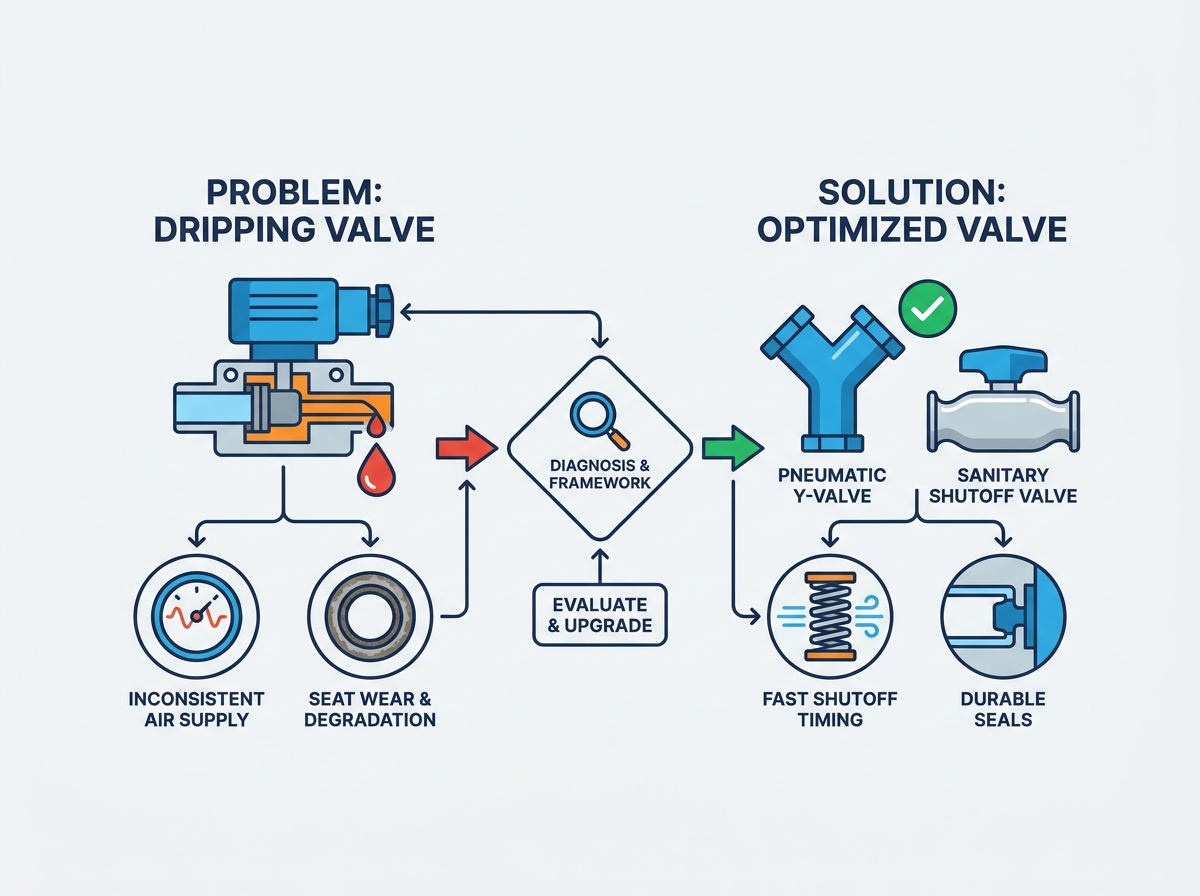
A pneumatic filling valve dripping is more than a minor nuisance. It directly impacts your daily yield, package seal integrity, and line downtime. When fluid escapes between fill cycles, operators often blame the physical valve immediately. However, chronic dripping requires a much deeper, systematic evaluation. You must investigate actuation timing, mechanical wear, and the surrounding pneumatic infrastructure. Masking the symptom temporarily costs your facility significant money. This guide breaks down exactly how to diagnose the true root causes behind these drips. We provide an evidence-based framework for making smarter maintenance decisions. You will learn precisely when to rebuild existing equipment versus upgrading. Transitioning to a purpose-built liquid filling valve often eliminates persistent failures entirely. By the end, you will understand how to permanently stop product waste and improve overall operational efficiency.
Sluggish shutoff timing is frequently caused by inconsistent plant air supply or restricted exhaust ports, not just internal valve failure.
Repeated failure of PTFE or elastomer seats indicates it is time to transition from temporary rebuilds to total valve replacement.
Upgrading to a pneumatic Y filling valve provides superior flow dynamics and faster, cleaner shutoffs for difficult fluids.
High-compliance environments require a dedicated sanitary shutoff valve to mitigate the contamination risks associated with product drip.
Every unnoticed drip on a packaging line chips away at your operational margins. You must quantify this business problem carefully to understand its true severity. A single drip per cycle adds up quickly on high-speed lines. This leads to immediate product giveaway. You literally package more fluid than required. Over a year, this giveaway can equal thousands of gallons of lost product. Rejected batches also skyrocket. Quality control systems catch under-filled or contaminated containers, forcing costly rework.
Labor costs represent another hidden penalty. Maintenance teams spend hours wiping down machinery instead of performing proactive work. These cleaning hours directly drain productivity. Beyond immediate product loss, secondary failures frequently emerge downstream. Drips easily fall onto the container sealing area. When fluid coats the rim, heat sealers fail to bond properly. This causes weak seals. Faulty capping occurs when threads become slick with leaked liquid. Spoiled products inevitably reach consumers, damaging brand reputation.
You need strict success criteria to define a permanent fix. Acceptable solutions must deliver a crisp, repeatable shutoff every time. The valve plug must seat instantly without trailing fluid. You must achieve zero dead-leg contamination. Fluids cannot linger in hidden pockets. Finally, the chosen solution requires minimal maintenance intervention. A truly repaired line runs for millions of cycles without requiring constant adjustments or fresh seals.
You must evaluate your pneumatic infrastructure before tearing apart a dripping valve. Actuation timing dictates how quickly a valve closes. Inconsistent air pressure delays the actuator's spring-return stroke. It also slows double-acting strokes. When closing speed drops, fluid continues to flow for a fraction of a second. This brief delay causes the classic trailing drip. Air supply deficits rank as the most common, yet overlooked, cause of poor shutoff performance.
Implementation realities on the plant floor often reveal hidden bottlenecks. You should look for specific mechanical restrictions outside the valve itself. Evaluate the following pneumatic components immediately:
Clogged Exhaust Silencers: Silencers naturally collect dust and oil over time. A restricted silencer prevents air from venting rapidly. This creates backpressure and slows down the closing stroke.
Failing Solenoid Valves: Solenoids control the air routing. Worn solenoid seals leak air internally, reducing the total pressure delivered to your main actuator.
Micro-Leaks in Supply Lines: Small pinhole leaks in polyurethane tubing cause pressure drops. They rob the actuator of the necessary force to compress the internal spring.
A simple expertise check separates seasoned technicians from novices. Before you dismantle the valve body, verify the facility's compressed air supply. Do not trust the gauge at the compressor room. You must measure the pressure directly at the valve inlet under full-load conditions. The pressure must meet the manufacturer's required operating specification. A sudden drop in line pressure during peak operation leaves micro-gaps between the plug and the seat.
Table 1: Pneumatic Timing Diagnostic Checklist
Component | Common Failure Mode | Impact on Shutoff Timing | Action Required |
|---|---|---|---|
Exhaust Silencer | Dust/oil accumulation causing blockage | Slows spring-return closing speed | Replace silencer elements quarterly |
Solenoid Valve | Internal seal wear or sticking spool | Delays air routing to the actuator | Test voltage and replace solenoid |
Air Supply Lines | Pinhole leaks or pinched tubing | Reduces seating force against fluid pressure | Conduct soap bubble test and replace lines |
Even perfectly timed actuators cannot compensate for severe mechanical degradation. You must perform a root cause analysis on the wetted components. Abrasive particulates in your product naturally score the valve seat and plug. Chemical degradation softens elastomer seals over time. Repeated dry-cycling generates extreme friction. This friction quickly strips away protective coatings and warps the sealing surfaces. Once the seat sustains damage, fluid finds a pathway to escape.
Many facilities default to rebuilding valves. Replacing O-rings and seats seems cost-effective initially. However, implementation risks run high. Machined tolerances inside the stainless steel valve body degrade slightly with every cycle. New seals cannot seal against a warped or grooved body. A rebuilt valve rarely performs exactly like a new one. You will likely experience diminishing returns on your labor investment.
Watch out for the classic 60-day failure pattern. If a rebuilt valve begins dripping again within 60 days, you have a definitive indicator of irreversible damage. This short lifespan signals permanent body warping or stem misalignment. Continuing to rebuild a physically compromised valve wastes money and risks batch contamination.
You must establish a strict threshold for maintenance hours. Track how much time technicians spend rebuilding a specific unit. If labor and parts exceed the cost of a new unit annually, stop rebuilding. Replacement becomes the objectively sound business decision. Upgrading guarantees a fresh internal geometry and restores reliable shutoff performance.
When standard vertical valves repeatedly fail, you must explore different solution categories. The angled geometry of a pneumatic Y filling valve proves highly effective for difficult applications. This specific architecture minimizes fluid turbulence. It straightens the flow path through the body. Less turbulence means viscous or fast-flowing liquids exit the nozzle cleanly. You eliminate the chaotic fluid dynamics causing erratic drops.
The features directly drive better outcomes. These valves offer an exceptionally high flow capacity (Cv). You can push more volume through a smaller footprint. This high capacity pairs perfectly with rapid spring-to-close actuation. The actuator cuts the fluid column instantly. This precise mechanical action eliminates trailing drips effectively. The angled design also drains completely, preventing old product from stagnating.
Secondary leak paths often ruin standard valves. Fluid travels up the actuator stem and leaks from the top. Modern Y valves utilize self-adjusting packing glands. These spring-loaded V-rings maintain constant pressure on the stem seal. As the seal wears naturally, the spring pushes down to eliminate any gaps. You rarely need to manually tighten the packing nut.
Scalability matters for automated lines. You must assess the valve's cycle-life rating carefully. Automated, high-speed filling demands extreme durability. Look for equipment rated for over one million cycles. A robust design handles continuous throughput demands without requiring mid-shift maintenance. Investing in premium actuation ensures long-term reliability.
Regulated industries operate under entirely different security and compliance realities. Food, beverage, and pharmaceutical processing facilities face strict government oversight. A dripping valve in these environments creates immediate bacterial risks. Lingering product on the filling nozzle invites microbial growth. You cannot risk contaminating an entire batch due to poor valve architecture.
You must evaluate equipment against stringent hygienic dimensions. Standard industrial valves utilize threaded connections and deep O-ring grooves. These features create microscopic harbor points for bacteria. High-compliance environments demand a dedicated sanitary shutoff valve. A proper design features a completely crevice-free internal cavity. Fluid flows smoothly without catching on sharp edges. This prevents biofilm formation and simplifies the cleaning process.
Compatibility with automated cleaning protocols is non-negotiable. Your shutoff solutions must withstand Clean-in-Place (CIP) and Steam-in-Place (SIP) cycles. The internal elastomers must handle extreme temperature spikes and harsh caustic chemicals without degrading or swelling. If a seat swells during SIP, it will stick open and drip once production resumes.
Rely on verifiable evidence rather than trusting vague marketing claims. Many manufacturers label products as "hygienic" without formal testing. Look for verifiable certifications. Valid 3-A Sanitary Standards or EHEDG certifications prove the design meets strict cleanability requirements. You should also demand FDA-compliant elastomers. These certifications guarantee the materials will not leach harmful compounds into your product stream.
Choosing the right replacement requires a clear decision framework. You must match the specific valve type directly to your fluid characteristics. Low-viscosity fluids like water require different seating materials than heavy syrups. High-particulate fluids, such as salsa or scrubs, demand robust plug designs to prevent crushing particles into the seat. Temperature extremes also dictate your elastomer choices. Evaluate your media fully before browsing catalogs.
Vendor evaluation carries equal weight to product specifications. Do not simply buy the cheapest option. Prioritize suppliers providing transparent cycle-life testing data. You want engineering proof, not just sales brochures. Ensure the vendor stocks readily available spare parts regionally. Waiting weeks for a replacement seal kit halts production entirely. Localized technical support also provides critical assistance during unexpected breakdowns.
Table 2: Solution Selection Matrix
Fluid Characteristic | Primary Challenge | Recommended Solution Type |
|---|---|---|
High Viscosity (Syrups, Creams) | Sluggish flow and stringing drips | Pneumatic Y Filling Valve (High Cv) |
High Particulate (Sauces, Scrubs) | Seat scoring and incomplete closure | Hardened Stainless Steel Plug / PTFE Seat |
Strict Hygiene (Pharma, Dairy) | Bacterial harboring in crevices | Certified Sanitary Shutoff Valve (3-A/EHEDG) |
Stop guessing about the root cause of your line failures. Take an actionable next step immediately. Conduct a baseline air-pressure audit on the filling line today. Attach a pressure gauge directly to the actuator inlet. Cycle the machine at maximum speed. Record the actual pressure drops. Perform this audit before ordering expensive replacement parts. You might discover a simple pneumatic restriction causes the dripping.
Resolving a dripping liquid filling valve requires moving past temporary band-aid fixes. You cannot simply wipe away the mess and hope the problem disappears. True resolution means actively addressing the mechanics of shutoff timing and seat integrity. You must verify air pressure, inspect exhaust silencers, and track rebuild failure rates systematically. Taking these analytical steps prevents recurring downtime.
Your final maintenance choices directly impact profitability. Investing in the correct physical architecture changes how your line performs. Whether you choose a robust Y-valve for difficult fluids or a certified sanitary shutoff for regulated spaces, the goal remains identical. You protect profit margins by ensuring precise, drip-free operation over millions of cycles. Stop managing drips and start engineering them out of your process completely.
A: Higher viscosity fluids create more resistance against the internal valve mechanism. Thick fluids resist the closing motion of the plug. This requires stronger actuator springs or higher control air pressure to achieve a fast, clean cut-off. Without sufficient closing force, the valve closes slowly and drips.
A: Yes. Drops in supply pressure prevent the actuator from applying the necessary seating force. If pressure dips during peak plant operation, the spring cannot fully compress the plug against the seat. This leaves micro-gaps between the plug and seat, allowing fluid to slowly leak out.
A: Lifespan depends heavily on application factors like cycle rate, fluid abrasiveness, and CIP temperature. However, high-quality PTFE seats in clean applications typically last between 1 to 3 million cycles. Once it begins dripping consistently, you must replace the seat to restore performance.