

T: +86-15888736999
No.67, Wutong Rd, Three-Two Rd Binhai Industrial Park, Economic & Technoloical Development Zone, Wenzhou, Zhejiang, China

Views: 0 Author: Site Editor Publish Time: 2026-11-02 Origin: Site


Tri-clamp connections often look deceptively simple to operators on the processing floor. We design them for rapid assembly, easy teardown, and reliable hygienic sealing. However, they remain highly susceptible to human error and environmental stress over time. A single tri clamp gasket leak is rarely just a minor maintenance nuisance. Instead, it represents potential batch contamination, severely compromised sterility, and expensive unplanned downtime. Your process lines demand absolute reliability, meaning temporary fixes will eventually fail. We must move beyond reactive tightening to permanently resolve these failing joints. This article provides a systematic framework for diagnosing root causes accurately. You will learn how to evaluate elastomer compression, align piping structures correctly, and select resilient materials. By applying these proactive field checks, you can permanently stabilize your operations and maintain strict compliance.
Over-tightening is the leading cause of gasket failure, leading to elastomer extrusion into the product stream and subsequent seal degradation.
Perfect alignment of the sanitary tri clamp ferrule is non-negotiable; relying on the clamp to pull misaligned pipes together guarantees uneven pressure and eventual leaks.
Sanitary gasket material must be matched not just to the product, but to the specific thermal and chemical realities of your CIP/SIP cycles.
Implementing standardized field checks and torque-limiting hardware transforms joint maintenance from guesswork into a repeatable, compliant process.
A weeping joint introduces severe contamination risks directly into your system. It creates a highly active micro-environment for dangerous bacterial growth. This persistent moisture attracts pathogens quickly and encourages biofilm formation. Such conditions threaten your FDA compliance status almost immediately. ASME BPE and EHEDG standards require pristine hygienic environments constantly. A compromised seal violates these strict sanitary protocols completely. Regulatory bodies zero in on failing joints during routine audits. They view visible weeping as a failure of systemic control.
Yield loss and facility downtime present massive operational hurdles. You lose valuable product every minute a connection weeps fluid. Emergency maintenance labor quickly drains valuable facility resources. Operators must stop production immediately to address the failure. They have to re-run full CIP/SIP protocols after breaching the closed system. This secondary cleaning process wastes hours of peak production time. You lose critical throughput and delay all subsequent processing batches.
Many operators rely on a dangerous "band-aid" maintenance approach. They simply tighten the component further upon seeing a drip. This operator reflex usually accelerates component failure rapidly. The extra tension crushes the internal elastomer beyond its recovery point. It also masks underlying systemic issues across the piping line. The actual root cause remains completely unresolved while pressure builds.
Engineers design a sanitary gasket to compress in a highly specific manner. It must achieve a perfectly flush internal seal during assembly. Manufacturers formulate elastomers to hit exact compression ratios under tension. Precise pressure creates a smooth, continuous transition between the metal pipes.
Over-tightening creates a widespread industry problem called internal intrusion. The elastomer material extrudes directly into the pipe ID. This artificial rubber barrier causes immediate fluid turbulence inside the pipe. It also creates dangerous soil traps behind the extruded lip. Bacteria thrive perfectly in these newly formed micro-crevices. The CIP fluids cannot reach behind the extrusion to clean it. Over-compression also destroys the natural elastomeric memory permanently.
The base material suffers permanent physical deformation instantly.
It loses all structural rebound capability under mechanical stress.
Thermal contraction during system cooling causes immediate weeping.
The flange edges become brittle and crack prematurely.
Under-compression creates the exact opposite defect, known as recess. The elastomer fails to meet the pipe ID completely. This specific gap forms a deep crevice for continuous product buildup. Heavy soils accumulate rapidly in this hidden dead space. Operators often notice weeping mostly during high-pressure transfer phases. The loose mechanical seal simply cannot hold dynamic fluid forces back. The connection might hold static water but fails under production flow.
You must adhere strictly to manufacturer-specified torque limits for every joint. Standard wing nuts usually require specific inch-pounds to function correctly. High-pressure components demand even higher measurable torque settings. Never rely on an operator's subjective physical "feel" during installation. Subjective tightening guarantees inconsistent compression across the entire facility. Use calibrated torque wrenches for every critical hygienic installation.
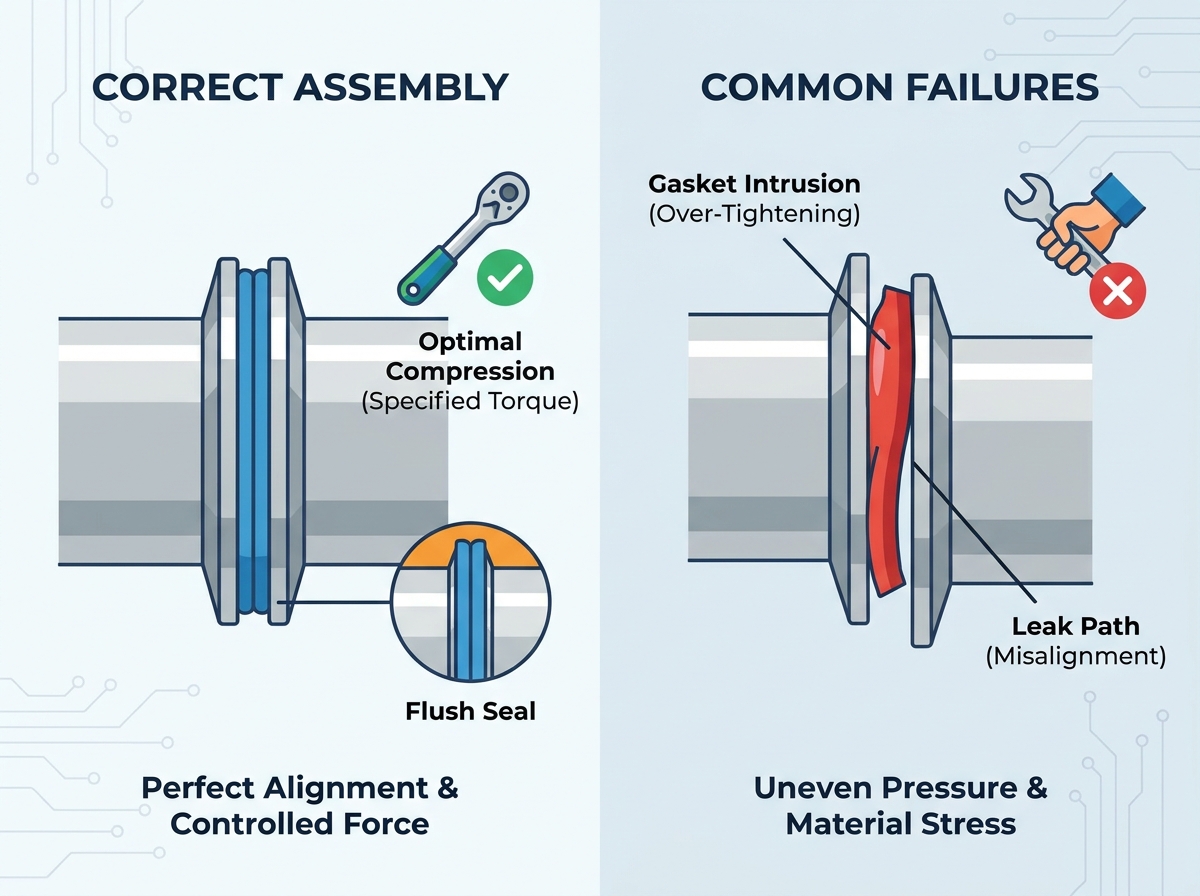
The sanitary tri clamp ferrule serves as your foundational mating surface. Its structural integrity entirely dictates the ultimate success of your seal. Engineers machine these metal faces to meet perfectly parallel. They must also remain entirely concentric during continuous operation. Any geometric deviation destroys the theoretical sealing potential immediately.
Piping systems often suffer from poor mechanical installation practices over time. Improper pipe hanging induces heavy directional stress on localized joints. Long stainless steel pipe runs undergo significant thermal expansion constantly. Hot internal fluids cause the exterior metal to grow linearly. This rapid growth shifts rigid pipes out of perfect alignment. Poor field welding techniques also warp the metal ends permanently. These combined factors lead directly to severely misaligned connections. Angular misalignment means the component faces meet at a harsh angle. Lateral misalignment means the centerlines do not match properly.
Never use the mechanical advantage of a stainless steel clamp fitting to pull heavy pipes. Operators often force misaligned pipes together intentionally during rush periods. They treat the closing mechanism like an industrial mechanical vice. This dangerous practice guarantees an inevitable catastrophic seal failure. It creates an extreme physical pinch point on one side. The opposite side suffers a dangerous microscopic fluid gap. The connection will inevitably leak under normal operational pressure. You simply cannot overcome bad pipe geometry through increased tension.
Pumps introduce constant dynamic stress into rigid fluid transfer systems. Positive displacement pumps generate significant pulsing forces through the lines. Unmitigated pump vibration shakes nearby connections relentlessly during production. This rhythmic motion exacerbates minor alignment issues significantly over time. A slightly stressed joint degrades rapidly under heavy mechanical vibration. You must install proper isolation techniques nearby to absorb energy. Flexible braided hoses help isolate this mechanical vibration effectively.
Selecting the correct material prevents premature seal degradation and failure. You must evaluate specific elastomer limitations carefully before installation. Facilities often stock the wrong materials for their specific chemical environments.
EPDM: Excellent for continuous steam and pure water applications. It degrades rapidly when exposed directly to fatty dairy products. Oily substances break down its chemical structure very quickly.
PTFE (Teflon): Highly chemically resistant against aggressive caustics and acids. It suffers from a destructive phenomenon called "cold flow". The material creeps outward under pressure and temperature fluctuations. It requires specialized envelope designs for dynamic thermal environments.
Silicone: Offers excellent flexibility across highly varied temperature ranges. It remains extremely vulnerable to harsh CIP chemical attacks. Physical tearing occurs easily during rushed manual installation.
FKM (Viton): Ideal for high heat and heavy oily environments. It performs quite poorly in continuous pure steam sterilization applications.
Rapid thermal shifts stress incompatible materials heavily during cleaning phases. Systems transition quickly from cold refrigerated product to hot steam. This drastic change causes extreme expansion and rapid subsequent contraction. The elastomer must absorb these geometric shifts flawlessly without failing. Incompatible materials stiffen and crack under this intense thermal stress. They fail to rebound properly when the system cools down. This loss of elasticity causes the joint to weep instantly.
You need a systematic framework for auditing current warehouse inventory. Compare your stock against actual process temperatures carefully today. Document the operating pressures for every specific fluid node. Verify all chemical exposures during sanitation phases with your supplier. Match these empirical variables to the correct elastomer profile.
Elastomer Performance and Compatibility Overview
Material Type | Optimal Applications | Known Limitations | Thermal Resilience |
|---|---|---|---|
EPDM | Steam, water, dilute acids | Fats, oils, hydrocarbons | Excellent in steam |
PTFE | Aggressive chemicals, high heat | Cold flow (creep), rigid | High heat capacity |
Silicone | Flexible connections, air lines | Tearing, harsh CIP acids | Broad range, flexible |
FKM (Viton) | Oils, fatty products, high heat | Continuous pure steam | Excellent dry heat |
Consistent maintenance requires robust inspection protocols implemented at the operator level. You must eliminate guesswork entirely from your daily assembly routines. Standardizing these manual checks stabilizes process reliability significantly over time.
Implement a standardized checklist for every single visual inspection. Operators should feel the metal surfaces before installing anything new.
Wipe the metal mating faces perfectly clean with a sterile cloth.
Inspect the internal metal surfaces for visible scratches visually.
Feel the outer edges for micro-pitting or warping manually.
Check the rubber component for noticeable discoloration or chemical fading.
Test the flexibility to ensure the item is not brittle.
Define strict facility criteria for retiring components permanently. Never reuse a compromised seal just to save a few seconds. Discard anything showing brittleness, cracks, or complete loss of flexibility. The risks far outweigh any perceived temporary convenience.
Evaluate the operational benefits of transitioning to torque-limiting nuts. These engineered nuts click audibly when they reach specific tension. They eliminate dangerous human error entirely during manual assembly. Consider using specialized sanitary torque wrenches for all critical nodes. You should also evaluate double-pin high-pressure clamps for heavy lines. They provide superior mechanical stability for high-vibration sections. The double-pin design distributes mechanical load much more evenly.
Stop relying on reactive run-to-failure models immediately across the plant. Shift your strategy to proactive time-based replacement protocols instead. You can also implement robust cycle-based maintenance schedules effectively. Analyze empirical wear data to determine exact replacement intervals accurately. Change components before they extrude, crack, or fail entirely. Predictive maintenance stabilizes the entire production schedule effortlessly.
Tri-clamp leaks rarely happen randomly in modern processing lines. They are highly predictable outcomes of consistent operational oversight. Improper compression destroys the internal physical integrity of delicate seals. Poor piping alignment forces uneven pressure directly across the connection. Incorrect material specification accelerates chemical breakdown and thermal degradation.
Solving these persistent problems requires a fundamental shift in mindset. You must transition from reactive tightening to proactive mechanical auditing. Systemic stability relies on consistent, standardized maintenance practices every shift. Stop guessing torque values visually and start measuring them accurately.
Audit your most problematic and high-risk joints today. Verify that your pipe alignments remain perfectly parallel and concentric. Consult with a component specialist to standardize your materials properly. Implement calibrated torque procedures across your entire facility now. These immediate actions will secure your processing reliability permanently.
A: It depends on the clamp type and gasket material, but generally, wing nuts should be tightened to 25-30 in-lbs, while high-pressure clamps may require up to 50 in-lbs. Always use a torque wrench and follow manufacturer specs.
A: While technically possible if the gasket shows zero signs of deformation or wear, best practice in critical hygienic applications dictates single-use to guarantee seal integrity and prevent cross-contamination.
A: Thermal expansion and contraction. High temperatures cause the stainless steel and the gasket to expand at different rates. If the gasket material lacks sufficient thermal resilience (or is over-compressed), it cannot maintain the seal as the system cools.
A: Cold flow, or creep, is the tendency of solid PTFE to slowly deform and spread out under continuous mechanical stress (like clamp pressure), eventually loosening the seal and causing a leak.