

T: +86-15888736999
No.67, Wutong Rd, Three-Two Rd Binhai Industrial Park, Economic & Technoloical Development Zone, Wenzhou, Zhejiang, China

Views: 0 Author: Site Editor Publish Time: 2026-11-13 Origin: Site


In high-containment pharmaceutical manufacturing, the physical transfer of sterile, potent APIs is the most vulnerable point for both product contamination and operator exposure. Every time operators move materials between classified zones, they risk compromising the entire batch. While facility design can successfully separate cleanroom grades, transferring materials across these boundaries requires direct mechanical intervention. For high-stakes applications, relying on traditional airlocks or standard soft-wall connections introduces unacceptable compliance and operational risks. Conventional methods simply fail to provide the absolute containment modern pharmaceutical guidelines demand.
Integrating an alpha beta valve sterile transfer system effectively bridges Grade A environments securely. However, achieving a seamless, compliant powder-handling layout requires strict alignment between the valve's mechanical tolerances, the active/passive configuration, and facility workflows. In this guide, you will explore the critical mechanics behind these split-valve systems. We will show you how to configure functional layouts, evaluate safety interlocks, and overcome real-world validation hurdles.
Configuration dictates workflow: The placement of the active (fixed) and passive (mobile) halves determines the ergonomic viability and footprint of your aseptic powder transfer layout.
Evaluation requires containment data: A viable sterile alpha beta valve must provide verifiable, third-party SMEPAC testing data proving containment limits (often down to nanogram levels) alongside sterility assurance.
Integration is harder than installation: Real-world adoption risks center on seal degradation, manual docking ergonomics, and CIP/SIP validation complexities, requiring rigorous vendor vetting beyond baseline specifications.
Traditional transfer methods constantly struggle to maintain absolute sterility. Standard airlocks and basic bagging systems often fall short when handling Highly Potent Active Pharmaceutical Ingredients (HPAPIs). They risk exposing operators to toxic airborne particulates. Simultaneously, these older systems risk exposing the sterile product to environmental microbes. You cannot afford either scenario in modern pharmaceutical manufacturing.
Industry experts refer to standard connections as having a "ring of concern." When you disconnect a standard butterfly valve, it exposes a small surface area to the ambient environment. This exposed disc face carries microscopic powder residue. When the valve reconnects, that contaminated face rotates into the sterile product stream. Alpha-beta split butterfly valves eliminate this exact problem. Engineers design them to minimize or entirely remove this exposed face. The disc splits into two halves. These halves mate securely together before opening. Only the internal faces touch the sterile product. The external faces remain locked against each other, staying clean and isolated.
A successful deployment hinges on specific success criteria. You must maintain ISO 5 or Grade A continuity during the entire transfer process. You must also achieve target Occupational Exposure Bands. For highly potent drugs, this means hitting OEB 4 or OEB 5 limits, restricting airborne particles to nanogram levels. Finally, the chosen aseptic powder transfer technology must integrate into existing Isolators or Restricted Access Barrier Systems (RABS) seamlessly. It should never impede your batch cycle times or slow down operators unnecessarily.
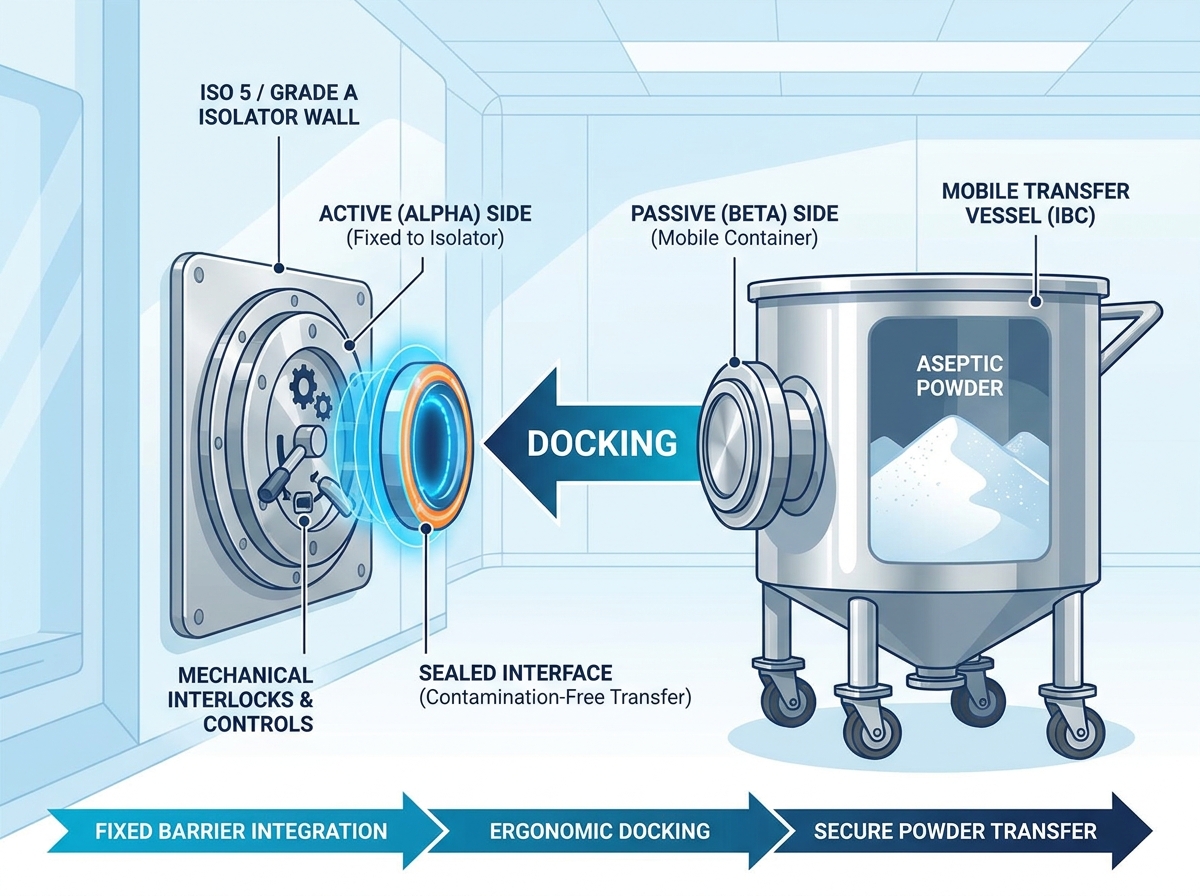
Designing a compliant layout demands a deep understanding of the two mating halves. The system functions securely only when you correctly position the active and passive components.
The active half, known as the alpha unit, serves as the control center.
Mounting: You typically integrate this half directly into your fixed barrier. Common mounting points include the wall of an isolator, a compounding containment unit, or a large process vessel.
Mechanics: It houses all the primary mechanical controls. The alpha unit contains the safety interlocks, operating levers, and pneumatic actuators. It does all the heavy lifting.
Layout considerations: You must position the alpha unit carefully. Operators need ergonomic access to dock the containers manually. If you use automated actuators, you must leave adequate clearance for pneumatic lines and maintenance access.
The passive half, known as the beta unit, travels with the product.
Mounting: You attach the beta unit to the mobile transfer vessel. This could be a stainless steel intermediate bulk container (IBC) or a single-use flexible bag.
Mechanics: It relies entirely on the active side for actuation. The beta half remains locked and sealed until operators properly engage it with the active unit. It contains no independent moving levers.
Layout considerations: You must map out floor space and lifting equipment meticulously. Stainless steel IBCs are incredibly heavy. Your layout must accommodate hoists or lift assists to handle the weight and alignment during the docking phase.
Your facility layout must account for the powder flow method. Does your process rely on gravity feed? Gravity systems require vertical stacking. You must position the active passive transfer valve components directly above the receiving vessel. This often requires multi-level facility designs or tall cleanrooms. Alternatively, if you use active flow, you might need vacuum or pneumatic assistance. Vacuum systems allow for horizontal or off-angle docking. This offers more flexible facility footprints but introduces complex pneumatic lines into the cleanroom layout.
To ensure a flawless transfer, operators generally follow these standard docking sequence steps:
Align the mobile beta container directly with the fixed alpha port.
Engage the beta flange into the alpha receiver slots.
Rotate the beta unit to lock it into place, triggering the mechanical interlocks.
Actuate the alpha lever to open the newly joined split disc.
Commence product transfer while maintaining isolation from the ambient environment.
Not all containment valves deliver equal performance. You must scrutinize several core engineering dimensions before specifying a valve for your facility. Taking manufacturer claims at face value often leads to costly validation failures.
Assess the machining quality of the disc and seal interfaces closely. Tight tolerances are absolutely non-negotiable. Even a micron-level gap can allow powder ingress between the active and passive faces. Manufacturers must use advanced CNC milling to ensure perfectly flat mating surfaces. If the discs do not mate perfectly, powder will migrate into the connection joint. This compromises containment the moment operators separate the two halves.
Modern pharmaceutical processes rely heavily on aggressive sterilization cycles. Your valve components must survive these routines.
VHP Compatibility: Facilities widely use Vaporized Hydrogen Peroxide (VHP) to decontaminate isolators. Seals and elastomers must withstand repeated VHP exposure. Poor quality rubber will suffer from rapid embrittlement, cracking, and eventual failure. Always specify high-grade EPDM or FKM elastomers designed for VHP environments.
WIP/CIP/SIP: Evaluate how easily the sterile alpha beta valve integrates with Wash-in-Place, Clean-in-Place, and Sterilize-in-Place utility lines. You must ask critical questions. Does the valve design harbor dead legs? Are there crevices where cleaning fluids cannot reach? Smooth, highly polished internal surfaces are mandatory for successful riboflavin clearance testing.
You cannot rely on operator perfection to maintain containment. Mandatory fail-safe mechanical interlocks are a strict requirement. The active valve must physically refuse to open unless the passive beta side docks perfectly. Furthermore, the system must lock the beta container in place while the valve remains open. Operators should never be able to undock the container until they fully close and secure the valve disc.
Feature Category | Standard Butterfly Valves | Split Alpha-Beta Systems |
|---|---|---|
Exposed Surface Area | High (Entire disc face exposed) | Minimal to None |
OEB Capability | OEB 1 to OEB 2 | OEB 4 to OEB 5 (<1 µg/m³) |
Safety Interlocks | Manual / Optional | Mandatory / Mechanical Fail-safe |
CIP/SIP Integration | Requires manual breakdown often | Highly integratable with automated skids |
Cross-Contamination Risk | High during disconnection | Virtually eliminated |
Procuring a high-quality valve is only the first step. Integrating it into a live manufacturing environment uncovers several practical challenges. Recognizing these adoption risks early allows you to engineer effective mitigations into your facility layout.
Stainless steel beta containers can become extremely heavy, especially when fully loaded with dense APIs. Misalignment during manual docking is a common issue. When operators force a misaligned heavy container into the alpha port, they risk two things. First, they risk repetitive strain injuries. Second, they can permanently damage the primary elastomeric seals. To mitigate this, require alignment guides or lift-assist integrations early in the layout phase. Automated docking rails take the physical burden off the operators and ensure perfect seal alignment every time.
Elastomeric seals act as the primary defense line against contamination. However, they naturally wear out from mechanical friction and harsh chemical exposure. Unpredicted seal failure leads to immediate sterility breaches and catastrophic batch losses. You must request mean time between failure (MTBF) data from the vendor. Establish rigorous predictive maintenance schedules. Replace seals before they fail, not after. Consider the downtime required to swap these seals when calculating your overall equipment effectiveness.
Proving sterility and containment simultaneously is notoriously complex. Regulators expect comprehensive proof. Factory Acceptance Testing (FAT) and Site Acceptance Testing (SAT) protocols must be meticulous. They must include surrogate powder testing. Engineers typically use naproxen or lactose as safe surrogates to mimic highly potent APIs. Air sampling pumps measure the nanogram-level release during the docking and undocking sequences. Additionally, you must run rigorous riboflavin coverage tests. These tests prove your CIP spray balls effectively clean every internal surface without leaving shadows or blind spots.
Selecting the right vendor requires moving past glossy brochures. You need hard data to back up safety claims.
Shortlist vendors who provide comprehensive SMEPAC test reports. SMEPAC stands for Standardized Measurement of Equipment Particulate Airborne Concentration. It is the gold standard for measuring containment performance. Ignore generic OEL estimates. Demand to see the actual raw data and testing methodologies. You need to know the exact test conditions, the surrogate used, and the ambient airflow dynamics during the test. A vendor unwilling to share detailed SMEPAC data is a massive red flag.
Traceability ensures compliance during regulatory audits. Ensure the vendor provides full FDA and USP Class VI certifications for all elastomers. You also need 3.1 material certificates for all wetted and contact parts. If a stainless steel component touches your product, you must be able to trace that steel back to the original foundry melt. Missing material documentation will immediately stall your IQ/OQ validation efforts.
Before you finalize your facility layout drawings, request a physical mockup. Ask the vendor to provide a dummy unit or a 3D-printed model. Run a trial of the active/passive docking process with your actual operators. Let them experience the ergonomic realities of the setup. Can they reach the levers comfortably? Does the lift-assist mechanism clash with existing ceiling fixtures? Answering these questions during the mockup phase prevents disastrous layout mistakes during construction.
Successfully deploying an alpha beta valve for sterile transfer requires moving well beyond simple product specifications. It demands a holistic view of your facility layout and processing goals. You must carefully balance the ergonomics of handling heavy active and passive components against stringent contamination controls.
Verify containment claims: Always demand third-party SMEPAC testing data before approving a vendor.
Prioritize ergonomics: Integrate lift-assists and alignment rails to protect operator health and prevent expensive seal damage.
Validate cleanability: Ensure your chosen valve supports automated CIP/SIP without harboring dead legs.
Enforce mechanical safety: Accept only systems with robust, fail-safe interlocks that prevent accidental disconnection.
By adopting a skeptical, evidence-based evaluation process, you protect both your sterile product pipeline and the personnel operating the equipment.
A: Both utilize alpha-beta mechanics to maintain containment. RTPs are traditionally used for transferring solid components, instruments, or environmental monitoring tools into isolators. Conversely, SBVs are specifically engineered for the direct, gravity-fed, or vacuum-assisted transfer of bulk powders and APIs.
A: Yes. High-containment aseptic valves are designed to provide bidirectional protection. They keep the internal product completely sterile, which protects the product quality. Simultaneously, they prevent the escape of hazardous HPAPIs into the room, which protects the operator's health.
A: Yes, many modern layouts utilize single-use flexible bags with integrated rigid beta ports. This eliminates the need for cleaning and validating mobile stainless steel containers. The active alpha side remains stainless steel and remains permanently fixed to the process equipment.
A: This depends heavily on usage frequency, VHP exposure, and CIP chemicals. Typically, preventative maintenance schedules dictate seal replacement every 6 to 12 months. However, vendors should supply specific wear data and MTBF calculations based on your unique operating parameters.